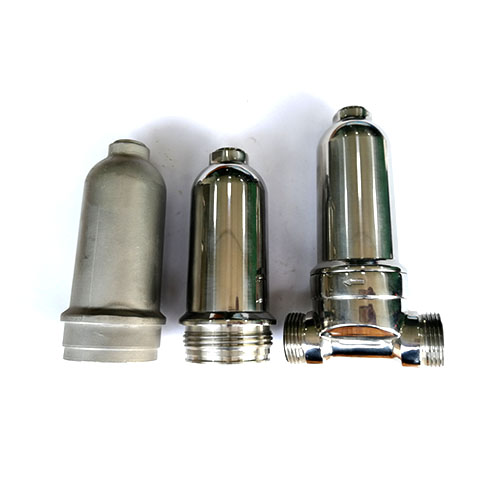

How to prevent cold insulation in stainless steel precision castings
Due to the poor flow properties of stainless steel, in order to preventStainless steel precision castingIf the parts produce cold insulation and the castings cannot be poured, the structure of the pouring system should be simple, and the cross-sectional size should be larger than that of cast iron; dry or hot castings should be used; the pouring temperature should be increased appropriately, generally between 1520 degrees and 1600 degrees Between degrees Celsius, due to the high pouring temperature, the molten steel overheats greatly and maintains the liquid state for a long time. However, if the pouring temperature is too high, it will cause coarse grains, cracks, pores and sand adhesion. Therefore, the pouring temperature of generally small-sized, thin-walled and complex-shaped castings is about the melting point temperature of steel plus about 150 degrees Celsius, while the pouring temperature of larger-sized, thick-walled castings is about 100 degrees Celsius higher.
Since the shrinkage of stainless steel precision castings is much greater than that of cast iron, in order to prevent shrinkage cavities in castings, riser methods, condensation methods and supplementary methods are mostly used in the casting process to achieve continuous solidification.