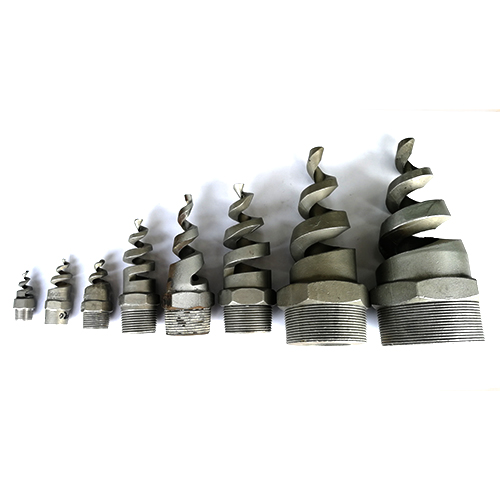

Spiral nozzle flow channel design analysis: aperture control and process balance
1. Structural characteristics of spiral nozzle flow channel design
The flow channel design needs to take into account the fluid dynamics characteristics and manufacturing process requirements. Common spiral flow channels are designed with spiral grooves at specific angles to produce a controllable vortex effect when the fluid passes through. This structure can not only ensure the stability of the flow process, but also maintain an appropriate flow velocity distribution. During the design process, it is necessary to consider the matching relationship between the gradient curve of the flow channel section and the inlet angle to avoid flow separation or excessive energy loss.
Some specially structured flow channels adopt a multi-section design scheme, with differentiated cross-sectional shapes in different sections. Through this segmented control method, the flow parameters can be gradually adjusted. This type of design requires careful calculation of the ratio of the length and diameter of the flow channel to ensure a natural and smooth transition between each section.
2. Key points in the process of aperture control
The stability of the hole diameter directly affects the uniformity of the outflow characteristics. During the processing process, material properties, tool parameters and cutting amount will have a significant impact on the quality of the hole. Using a step-by-step machining strategy, first roughing to leave an appropriate margin, and then through fine trimming to achieve the expected size. This step-by-step process route helps to improve the consistency of the size.
The impact of temperature changes on pore size cannot be ignored. In actual production, it is necessary to establish a corresponding relationship between ambient temperature and pore size changes, and offset the effects of thermal expansion and contraction through process compensation. At the same time, stabilization treatment after processing is also very necessary. Appropriate aging treatment can release internal stress and promote dimensional stability.
3. Collaborative optimization of flow channels and apertures
Flow channel design and aperture control require systematic consideration. The degree of matching between the two determines the overall performance. A more ideal solution is to establish a flow channel-aperture correlation model during the design stage and find a reasonable parameter combination through simulation analysis. In actual manufacturing, appropriate adjustments need to be made based on equipment conditions and material characteristics to achieve a balance between theoretical design and process realization.
Experience shows that the use of dynamic correction methods can often achieve better results. That is, multiple sets of parameter tests are conducted during the trial production stage, and the design plan is improved based on the measured data. This kind of iterative optimization based on actual data can gradually approach a more reasonable process plan.
Conclusion
The flow channel design and aperture control of the spiral nozzle is a process issue that requires comprehensive consideration of many factors. Successful cases show that only by organically combining theoretical calculations with practical experience, and finding the right balance between structural design and process control, can qualified products that meet the use requirements be manufactured. This requires both solid professional knowledge and rigorous process verification. It is this fusion of scientific attitude and craftsmanship that promotes the continuous progress of manufacturing technology.