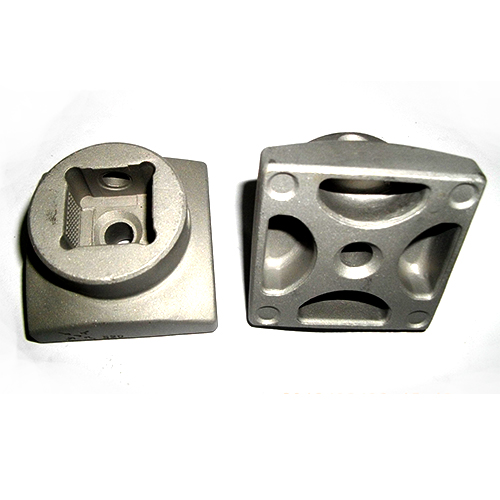

The core advantages of alloy steel investment casting: Why is this method often used for complex structural parts?
Unique craftsmanship adapts to complex designs
Alloy steel investment casting uses a disposable ceramic mold shell, which melts the model to form a cavity and injects molten alloy steel. This method can replicate shapes with rich details, including holes with tricky angles, subtle textures or embedded channels. It provides an economical and reliable solution for complex geometric structures that are difficult to achieve with traditional processing. Designers do not need to simplify components due to process limitations, thereby promoting product functional innovation.
Excellent material performance and structural integrity
Alloy steel is known for its strength, toughness and corrosion resistance, and is suitable for harsh environments. Through investment casting, the internal structure of the component is dense, with fewer defects, and can maintain uniform mechanical properties. Compared with other methods, it reduces the number of welding or assembly links and avoids potential weaknesses at the seams. For components that need to withstand high pressure, high temperature or dynamic loads, this integral molding method significantly increases the service life.
Balance between economy and scalability
Although the initial mold cost is high, investment casting is suitable for mass production, and the unit cost decreases with the increase in output. It reduces the need for subsequent machining, saving materials and man-hours. For small and medium-sized complex parts, this process can find a balance between quality and cost, and is especially suitable for aerospace, medical equipment, energy equipment and other fields.
Outstanding surface quality and dimensional stability
Thanks to the delicate surface of the ceramic mold shell, the casting has a good finish after molding and often does not require additional polishing. At the same time, process control can ensure small dimensional deviations and high consistency in repeated production. This is crucial for complex components with strict assembly requirements, reducing the uncertainty of overall production.
Conclusion
Alloy steel investment casting is not, but its adaptability, reliability and economy in the manufacturing of complex structural parts have made it a mainstream choice in the industry. With the advancement of material science and process control, this technology will continue to support the development of the manufacturing industry in a more integrated and durable direction. For fields that pursue structural innovation and stable performance, it undoubtedly provides a solid technical foundation.